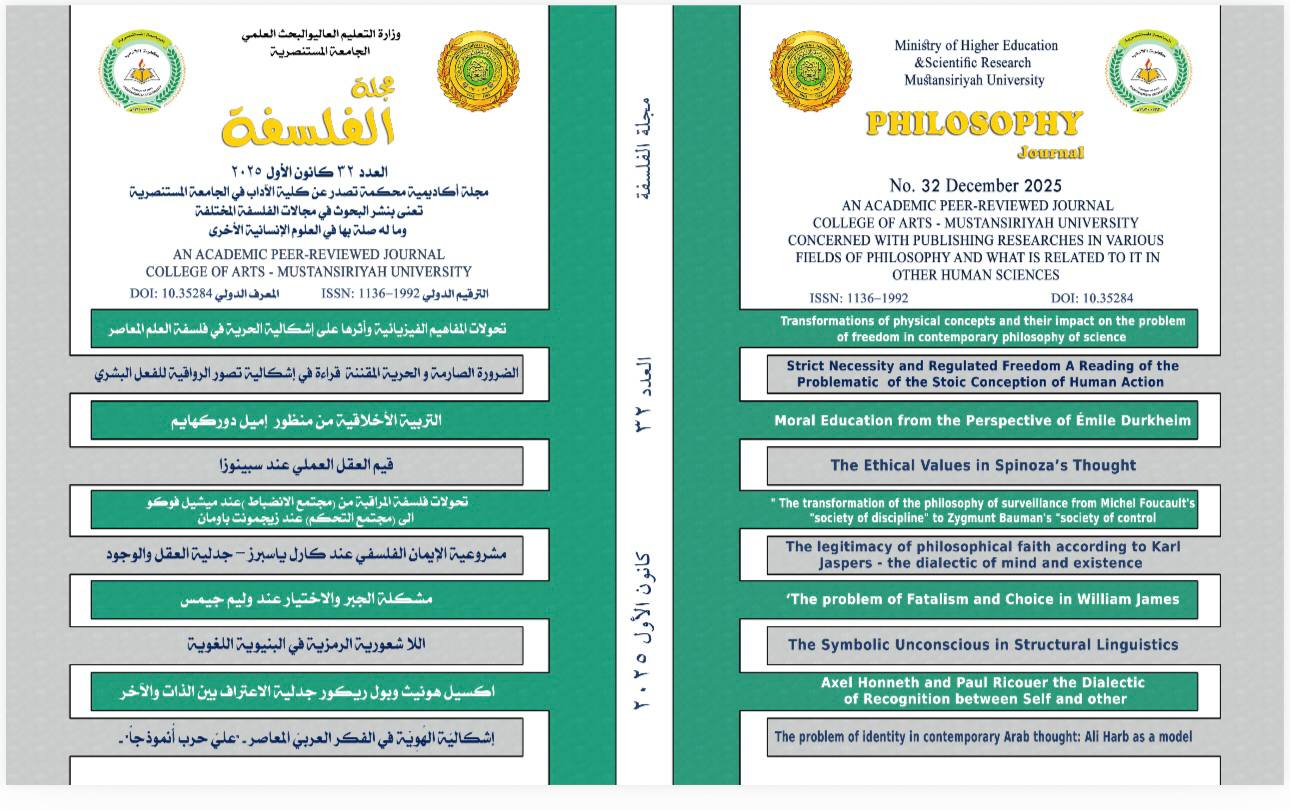
Transformations of physical concepts and their impact on the problem of freedom in contemporary philosophy of science
Keywords:
فلسفة العلم المعاصر، الحرية الإنسانية ،الحتمية الكلاسيكية، النسبية العامة ،ميكانيكا الكم ،الزمان والمكان ،الإرادة الحرة ،السببية واللاحتمية ،بيرغسون ،آينشتاين ،هايزنبرغ ،الاستقراء العلمي ،الفلسفة الطبيعية ،الاحتمالية الكوانتية ،الزمن البيولوجAbstract
This study explores the problem of human freedom within the framework of contemporary philosophy of science, tracing how major shifts in physical concepts have reshaped the debate on determinism and free will. Beginning with classical mechanics and its rigid notions of absolute time, space, and mass, the research follows the transformative influence of Einstein’s relativity and quantum mechanics, which introduced indeterminacy and probabilistic interpretations of nature. The collapse of classical determinism challenged the mechanistic view of reality and opened philosophical space for reconsidering freedom beyond causal necessity. The study analyzes key scientific and philosophical positions, including those of Heisenberg, Bergson, and Einstein, emphasizing how modern science questions the predictability of events and the fixity of laws. It argues that freedom is no longer antithetical to scientific reasoning but is instead deeply embedded within the indeterminacy of quantum processes and the dynamism of living systems. Ultimately, the study affirms that the new scientific worldview grants a renewed legitimacy to the concept of human agency..
Downloads
Published
Issue
Section
License
Copyright (c) 2026 أ.م.د. أكرم مطلك محمد

This work is licensed under a Creative Commons Attribution 4.0 International License.