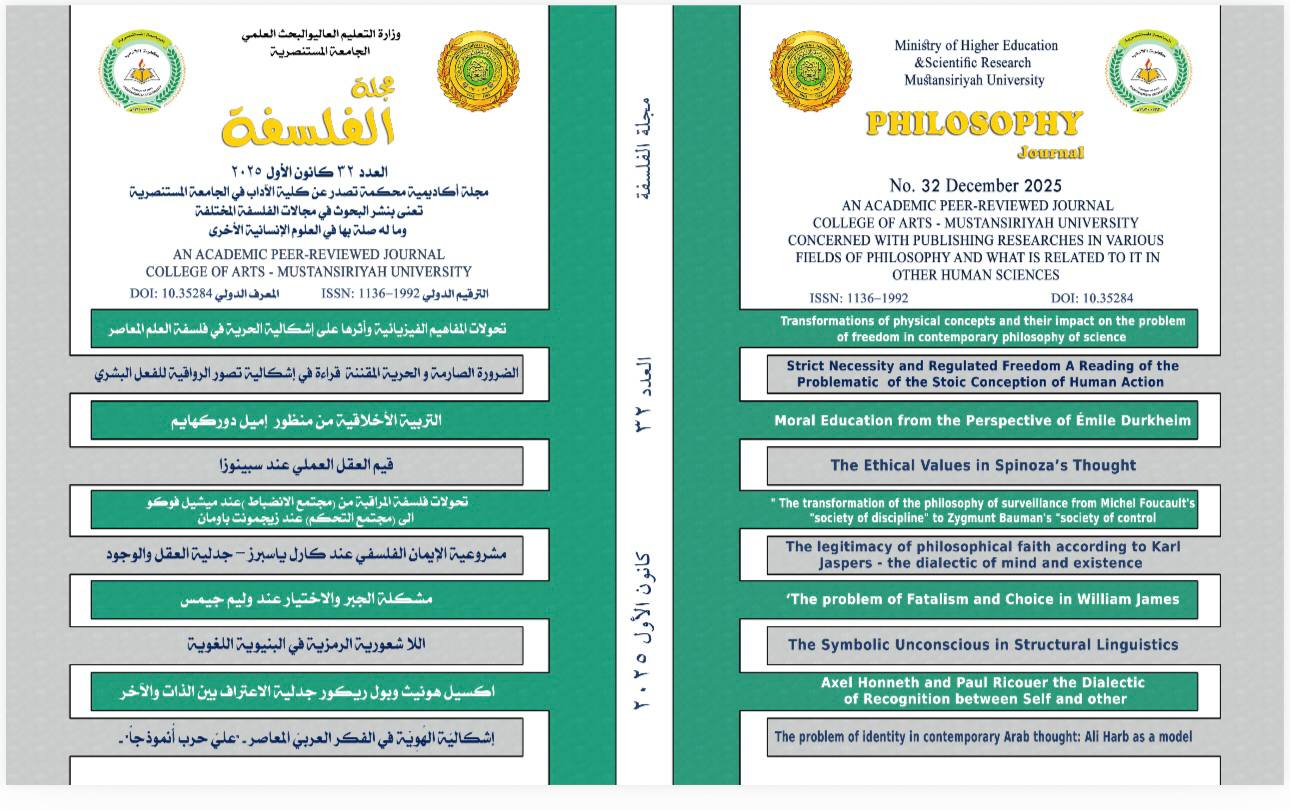
The problem of Fatalism and Choice in William James’ Philosophy
Keywords:
(وليم جيمس – البراجماتية - الجبر – الإختيار – مُشكلة – المُصادفة – الحتمية)Abstract
The problem of Fatalism and Choice in William James’s Philosophy stands as one of the central issues he examined within the framework of his pragmatic thought and his theory of free will. James firmly criticized and rejected strict determinism, advocating instead for the notion of free will not merely as a philosophical abstraction, but as an existential and psychological experience lived by the individual. He maintained that human beings possess the genuine capacity to make autonomous choices.
This study demonstrates how James viewed freedom as an essential component of human dignity, and how he believed that the world is not governed by rigid necessity, but rather by chance and plurality-that is, a world characterized by open possibilities. The paper also explores the connection between free will and moral responsibility, emphasizing James’s view that affirming human freedom entails not only the ability to choose but also the moral accountability for one’s actions, thereby reinforcing the philosophical grounds for reward and punishment.
The research aims to investigate the concepts of the determinism and choice in James’s philosophy, to analyze his stance on free will and its relation to responsibility, and to clarify how James conceives of the human being as a free agent within a world shaped by contingency and pluralism
Downloads
Published
Issue
Section
License
Copyright (c) 2026 م. د. إيناس صباح مهنا

This work is licensed under a Creative Commons Attribution 4.0 International License.